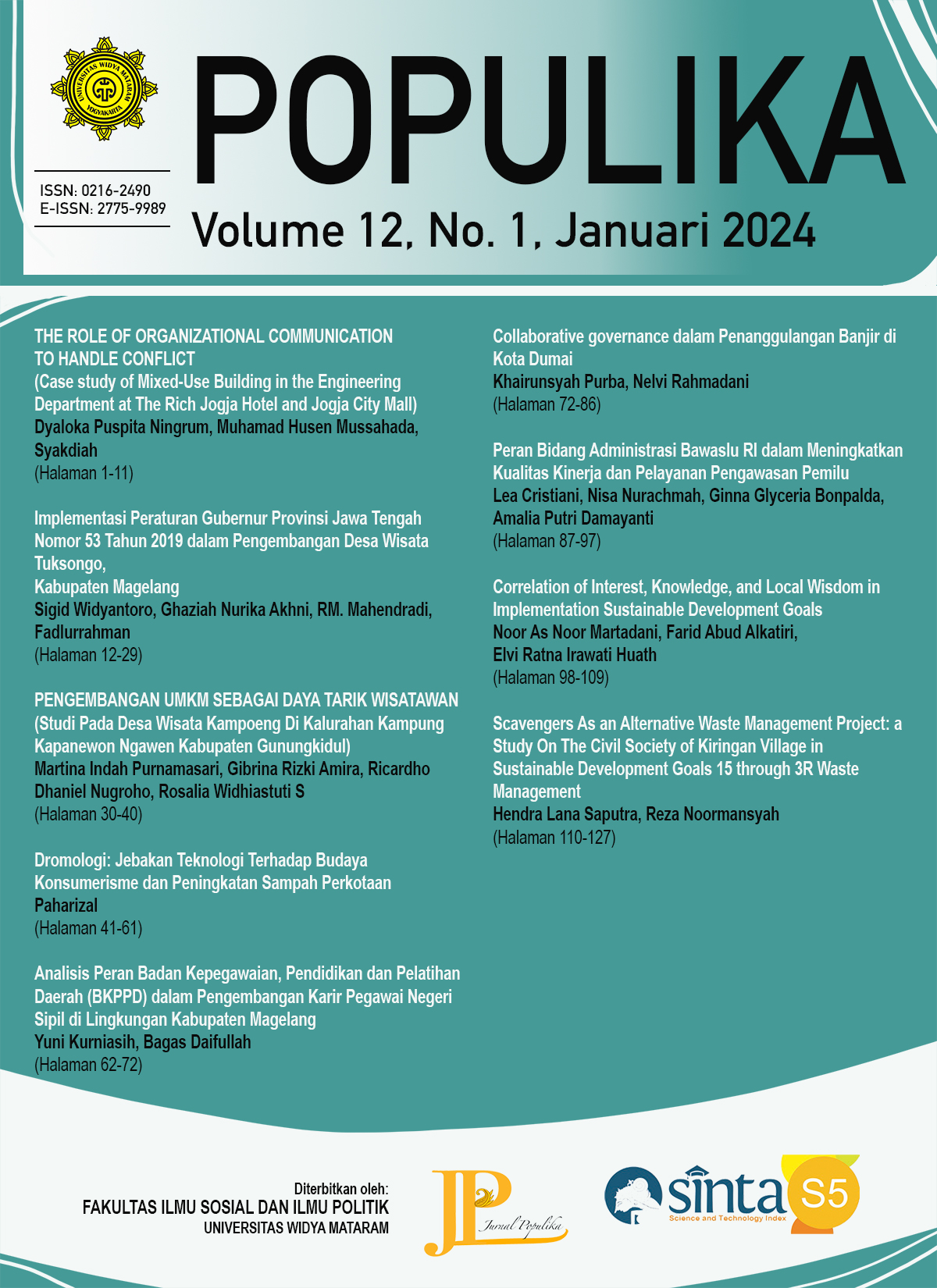
Dromologi : Jebakan Teknologi Terhadap Budaya Konsumerisme dan Peningkatan Sampah Perkotaan
DOI:
https://doi.org/10.37631/populika.v12i1.1223Abstract
Technological advances have brought the relationship between producers and consumers closer, so that consumers can directly choose the goods needed through an e-commerce system complete with a marketplace that offers various types and models that are continuously innovated and promotions are offered continuously. These offers make consumers tempted to continue shopping for these goods. This behavior, in turn, has an impact on increasing the volume of waste due to the delivery of goods in packing cardboard, plastic and so on, besides that the goods purchased are not utilized so that they end up in the trash. This research was conducted using a qualitative research method with a retrospective case study approach. Data collection was carried out with open, in-depth interviews and triangulation, to strengthen the analysis, this research also used secondary data obtained from various sources. In addition, this research was also carried out by direct observation at several research locations and comparative studies to other regions to get recommendations for waste management techniques that can be used as a suitable model to reduce waste volume. The research shows that the occurrence of acceleration and speed (dromology) has led humans to live in a culture of consumerism. People will become "crazy" shoppers, even though the consumer goods they buy are not the goods they need but the goods are bought because they only want them. Including food consumption goods, which often end up in the trash, an increase in the volume of food consumption waste can also occur at the distributor level in the process of shipping from primary producers to secondary producers. To overcome the increasing volume of waste in urban areas, proper management and processing is needed by involving all actors.
Keywords: Acceleration; Speed; Consumerism Culture; Waste Management; Waste
Downloads
Published
How to Cite
Issue
Section
License
Copyright (c) 2024 Rizal Paharizal

This work is licensed under a Creative Commons Attribution-ShareAlike 4.0 International License.


